Since rebuilding the brake callipers with new stainless steel pistons, I have been frequently getting the main brake warning, ABS and ETC lights (aka. “the three amigos”) on the dash after start if the vehicle has been stood for a few hours or more. The main brake warning light looks at the reservoir level, ABS pressure and hand brake lever. Restarting the engine clears the lights instantly and for the rest of the journey. Diagnostic tools show just one fault – the ABS pump pressure switch.
Any ABS system needs an accumulator (pressurised reservoir) to re-apply brake pressure automatically once the system has released the brakes on detecting a skid. On the RRC, this is a black painted sphere just outboard of the brake block, just in fornt of the bulkhead, and can just be seen above the white electrical plug in the photo. Obviously, this accumulator needs to be charged quickly to a specific pressure, so the pump has a pressure sensing switch which is connected to the ECU, telling the ECU not only whether the system is up to operating pressure, but enabling it to work out whether pressure is being reached quickly enough. A fully depressurised RRC system should reach full pressure in under 45 seconds. Failure to acheive the pressure in the alloted time brings on all three warning lights, though the system will still operate with the lights on if correct pressure is acheived (as in my case). The pressure switch diagnostic is a little misleading; it’s not usually the switch itself that has failed, it’s just the sensor reporting a related issue.
My fault was that the pump appears to be worn or tired, and is either not turning quickly enough or has internal wear which is allowing the fluid to be stirred rather than pumped through. I sourced a second hand pump, even though I dislike using second hand spares on such critical systems, as new pumps cost approximately £800. The pump was cleaned and given a quick test by plugging its pressure switch (the big green assembly on the top) and its motor power feed (white plug) into the RR before removing the old unit. The iginition was turned on for a couple of seconds just to check the pump spun up, but not for any longer in order to avoid damage from running it dry. The pump’s condition was unknown, but at least this basic check confirmed that it was worth proceeding with the rest of the work in swapping them over.
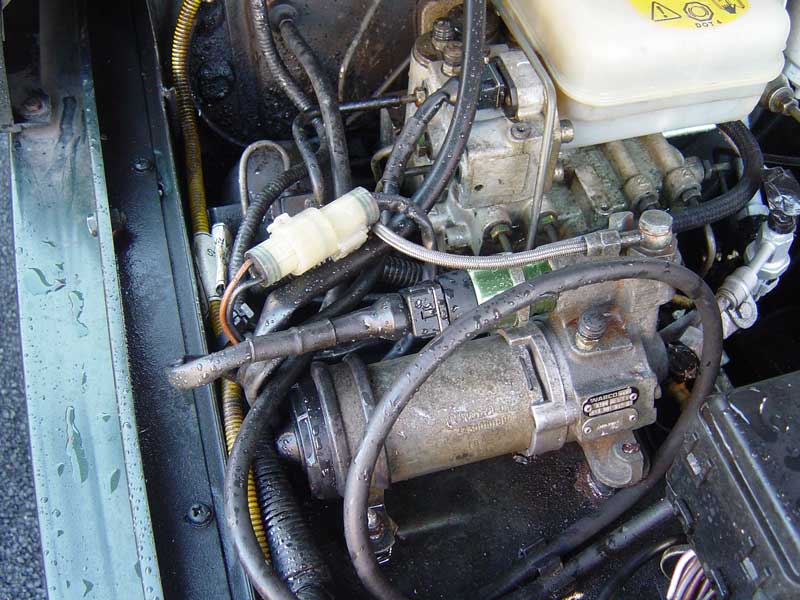 Once satisfied that the “new” pump was operable, the old pump was removed. This merely involved disconnecting both electrical plugs (already done for the new pump check), clamping the black braided hose from the reservoir and disconnecting it from the aft side of the pump, undoing the banjo bolt connecting the stainless steel braided outflow hose from the top of the pump, and then undoing the four nuts holding the vibration damping rubber feet (like miniature engine mounting rubbers) to the inner wing top.
The ruber feet of the new pump were already ruined – the rubber can detatch from the steel plates if force is applied to the rubber or opposite stud when trying to undo seized nuts, but the mountings for the original pump were in mint condition having been replaced not long ago, so these were transferred to the new pump. It’s important to use a spanner on the hexaginal plates of the mountings when undoing nuts on the associated end, and not to apply any torque to the rubber itself.
Installation was very simple, and is just the reverse of removal. Once fitted, the pump was bled using a pressure bleeder (EziBleed) and the nipple on the pump itself. Following that, with the pressure bleeder still attached, I cracked the banjo bolt on the outflow hose to try to bleed that part of the housing to try to purge the high spots of the pump. Finally, the accumulator was repeatedly bled to clear the air from the pressurised hose. This is done by opening the accumulator’s bleed nipple and repeatedly running the pump (by switching ignition on) for a few seconds at a time – this allows any bubles to collect at the top of the accumulator before being pumped out, rather than being pumped around the entire system by running the pump continuously.
Once the fluid from the bleed nipple to the catch tank was running reliably bubble-free, the nipple was closed, the system depressurised again and then tested by activating the pump and timing its cut-out.  The pump ran for just over 35 seconds and the main warning light and ETC light extinguished (ABS light stayed on as the vehicle was staionary, and the ABS needs motion of approx 4-6mph to self-test), indicating the system was working properly. I hosed the area off with water to prevent spilt fluid damaging the paint work , and this unfortunately did not dry off in time for the photo. Time will tell if the replacement pump is any good, but I won’t count my chickens just yet…

Speak Your Mind
You must be logged in to post a comment.