Stating the obvious, the first thing to do was jack up the vehicle, remove the front wheels and then disconnect and remove the front axle. A bit more complex than the rear axle, this means disconnecting the prop shaft (in this case completely removed), the two brake hoses and the steering drag link (again, completely removed). With the chassis supported and the weight off the springs, the U-bolts were all removed. The axle was then lifted up onto stands to allow me to drop the front end of each spring to the ground. The axle was then lifted off the stands and down to the ground and then rolled out the front to clear the vehicle.
 In this instance, once the old axle was cleared away, I used the clear space to uprate the front springs (detailed in another post in the suspension section). The new front axle was then given its final preparations for installation, which included fitting the QT Services diff guard. This had to be done now as the diff on later axles is much closer to the right hand spring and there will be insufficient space to fit the right hand bolt to secure the diff guard to its brackets. The brackets were cut off the old axle and, with the guard bolted in place at its rear near the pinion flange, welded to the new casing. I counter-bored the holes in the guard to use countersunk bolts on the front sides to make sure that the U-bolt would fit the narrow gap. The guard was also cleaned up and sprayed with galvanising paint.
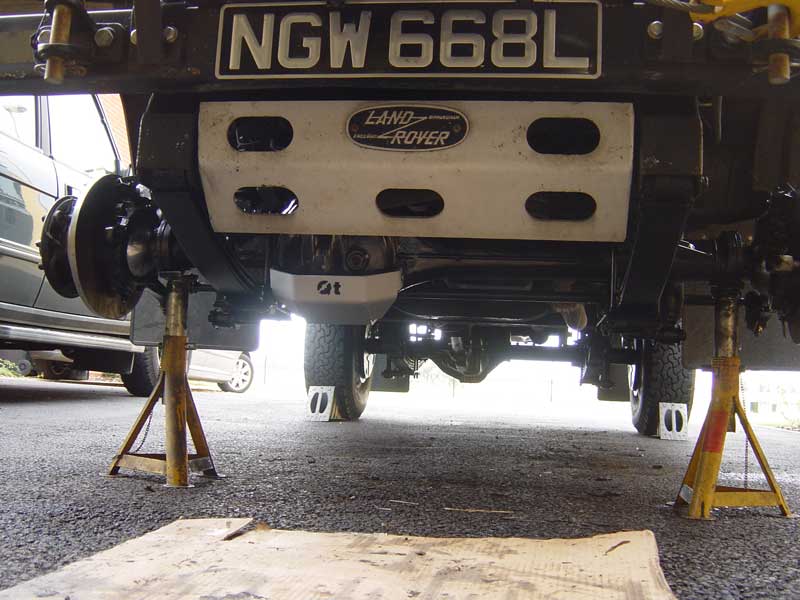 The axle was then rolled into position over the hanging springs and lifted onto stands. The old track rod was left on at this point just in case it was damaged. Once the axle was high enough out of the way, the springs were reattached to the dumbirons (and the steering guard reattached). With the springs secure (but not tightened), the axle was lowered onto the springs and the U-bolts installed. These, the spring plates and the areas of axle on contact with the U-bolts were coated with more black goo before assembling them and tightening their nuts. This included the specially shaped inboard right-side bolt which has to wrap around the inclined diff housing.
 With the axle bolted down to the springs, I found the track rod cleared the tops of the springs by about 1/16″, but that’s with the axle hanging and bending the springs down. Once the vehicle weight was put onto the axle and springs, the clearance increased to about 1/2″. This is pretty much what I had aimed for when working out the dimensions for the custom spring saddles, trying to have the shallowest saddles possible while ensuring the track rod didn’t touch the springs. As a wise man once said, “I love it when a plan comes together”.
 The prop shaft was then modified to suit the new inclined axis of the diff pinion. While Series vehicles normally have parallel pinion and and gear box axis, and thus have the prop yolks in line, coilers have inclined pinions and the prop yolks are offset. I checked my Range Rover and found the offset was simply set at 45 degrees, so I just copied that, undoing the the slip joint and reassembling it with the offset. It was then fitted to the vehicle, admitted twice (the first time I had it back-to-front, with the slip joint grease nipple hidden by the bell housing cross member). I was just fitting the penultimate bolt when I spotted the mistake first time around; at least I hadn’t tightened them up yet.
The new Defender track rod was fitted with the rod ends from the old Discovery rod, since they seemed to be in good order. The Defender rod is the same length, but is plain, so has no damper bracket or inboard clamp to foul the springs.
 I still need to connect the brake hoses to the callipers with some new lengths of copper-nickel piping around the swivel housings and sort of the drag link. I have a cunning plan for the latter – quick measurements suggest I need a drag ling 5″ longer than the original SIII rod, and as luck has it, the short section of the Discovery track rod (for making tracking adjustments without rotating the whole rod with its attached damper) is bang on 5″. I’ll be double checking those measurements again, because I’m not used to that sort of luck, but if need be, I think I can trim up to an inch off each end of the drag link and also the 5″ piece, so have a range of 3-6″ to cover the increased distance from the steering relay drop arm to the near-side swivel arm.

I have recently bought a 1972 series 3 109, with a 2 1/4 petrol engine. I have no experience with the Land Rover so this is a big learning curve for me. I have started the long process of tidying up and modifying the 109, as it is in half good condition. I have started by welding plates in the footwells and removing the redundant wiring as it was a Mountain Rescue vehicle in its former life.
I have a 3.5 EFI engine and gearbox to convert it to a V8, including ECU and loom, exhaust manifolds, plus the adapter plate and spigot plate. I am hoping the engine will fit to the 109 gearbox without too much grief.
The body is a little crinkled in places, but other than that, she is a good Landy.
What I would like to achieve, is a disc brake conversion, and power steering, as the engine has the pump fitted.
I an pleased to find your site, as it will give me some good advice as to what to look out for etc.
I have not read all of your site content yet, so I will thank you now, and continue to read.
thanks,
Ian.
Hi Ian
That sounds like a great project! I don’t know anything about mating V8s and Series transmissions, but it has been done successfully many times and is a great drive as long as you are sympathetic to the gear box.
There are easier ways of converting to disc brakes if that’s all you’re after. Zeus Engineering, Rocky Mountain and Heystee all have kits to convert your existing axles. Full axle swaps like mine are an option, but are a lot of work if you’re not after the other benefits they bring.
Good luck with it!
Nick
Ive got the same plan as Ian. Cuz of the new tax rule in Holland its not possible anymore to drive a 2.25 Diesel without paying the tax…
So the plan is to convert it to a petrol, V8 ofcourse if you have a choise.
But first i’m working on the brakes now, ive got some left over parts from a defender 90 ’86. The front axle in parts.
Will the swiffel/hub disc brakes fit on a 109 ’80??
Hi Chris,
Some people have managed to fit the later axle swivels and hubs to earlier axles, some by replacing the flanges on the axle, others by welding up the bolt holes and redrilling, and some by making a steel sandwich plate/adaptor ring that sits between the axle and the swivel housing. There are two big issues with doing this. Firstly, the half shafts will be of incorrect length and will need to be custom made or modified. Secondly, the track rod will want to go through the leaf springs and differential nose. How they resolved the latter problem I don’t know. Cranked roads won’t work. Perhaps they had the rode end holes in the swivel arms re-machined to reverse the taper, allowing the rod to be fitted beneath the springs and diff. Some swap the sides of the swivels and have their arms point forwards, connecting the drag link and track rod together to get around the lack of another connection on the left swivel for the drag link, but this will reverse the Ackerman angle (so the wheels toe in badly as you try to turn, the wheel inboard oft he turn pivoting less than the outboard wheel instead of more). I consider this a very bad thing though some seem to consider it irrelevant.
Have a look at some of the brake conversion threads at http://www.lr4x4.com to see some cheaper alternatives to the aftermarket kits that don’t require a full axle swap, but don’t discount the swap immediately – the axle swap brings not only better braking but also much tighter turning radius; my 109 now turns in a smaller circle than my wife’s Defender 90 rather than the enormous arcs it had with the old axles, even though all my vehicles have their stop-locks carefully adjusted to give the best turning radius available.
Thanks a lot!
Hi
I’m currently restoring a series 3 Sen and looking to convert to disc brakes. I have read your blog but unable to find pics if any of what needs to be removed off defender casing and what needs to be done to it to be able to fit it to leaf springs.
Any help would be appreciated
Many thanks
Phil
Hi Phil.
The front axle needs to have every bracket removed. You also need to remove the bump stops as they are on at the wrong angle for a leaf sprung system (coil axles rotate as the springs compress, leaf axles don’t). The new saddles will need to be attached to the axle with the same angle between their underside and the steering swivel axis or flats of the swivel pin mating faces. The saddles will be similar to the original axle’s, but taller to allow for the depth of the diff housing sitting over the spring. I can’t remember how tall I made mine and cannot measure them as I am no longer in the same country, but a figure of 8mm rings a bell. It is also a good height to get the track rod to clear the top of the springs. The bump stops need to be reattached so their tops are parallel to the saddles. However, you may decide to reduce the height loss by using 1-ton spring shackles, in which case you need to measure the change in inclination from front to back of the springs and alter the saddle position by that amount to keep the swivel pin axis constant in relation to the chassis, not the spring. This will also need to be reflected in the bump stops, which will now need to be out of parallel to the saddles by that same amount.
The rear axle needs all the brackets removing, but keep the bump stops. Fit spring saddles just like those on the Series axle at the same width spacing as the original axle and the same angle relative to the diff pinion. 88″ might need tall saddles to allow for the diff being further outboard on the later axles, sitting partially over the spring. 109s need just the standard saddles or replicas.
Hi,
Great site. I am just completing a RRC disc conversion on a S1 using std series axle cases front and back using sandwich plates.
Concerning the extra adjustment tube on the track rod, I did not consider it luck, more how LR decided to grow the lenght from a Series item, I was depending on this in order to be able to reduce the lenght to fit the modded axle.
What caster angle do you have? As I have used a Series axle case my caster is set by the suspension as is normal Series, however coiler axles have the swivel holes clocked by 9 degrees to give 3 degrees of caster with 12 degrees of diff tilt. Have you set the diff tilt to 9 degrees to let the suspension set the caster? As I have 0 degrees of tilt I have had to relieve the lower face of the diff nose to clear the track rod.
Hi Marc
I used 3 degrees castor angle, as is standard on the Series II, III and Defender/RRC/Discovery (and possibly the Series I). I didn’t adjust the swivel housing on the axle or any steering parts, the diff is inclines like on the later vehicles.
The drag link was the SIII link with the adjuster section of a Discovery/RRC track rod. The remainder of that track rod is a fair bit longer than the SIII drag link, and the drag link and adjuster are a bit too long for the late axle in the Series vehicle, needing a 1/2″ trim to each of the open ends to set teh right length. A simple mod compared to the other’s in the job.
Nick.
Nick, looking to do the same on my 88′
Do you have any images of the front steering arms ?
Cheers
Hi Ben,
I didn’t get a notification for your comment, so only just found it. I hope you haven’t been waiting long for a reply.
I dont have any photos of significance, but the arrangement is really simple – a Defender track rod to replace the two piece Discovery rod, as that types adjustment section and the steering damper foul the leaf springs, and a shortened P38 drag link (from the same donor as the PAS parts) with the internal threads tapped out to suit the standard rod end. The P38 rod ends are the same as Defender, Discovery and RR, so there is no compatability issue between rods, PAS box arm and swivel arms.
The steering damper was fitted using the SIII chassis bracket and piece of steel angle extrusion and two U-bolts to clamp around the P38 drag link. Before the PAS conversion, I used the original SIII drag link with the adjustment section of the scrapped Discovery track rod to extend it for the longer axle.
Hope that helps.
Nick
I’ve just about completely dismantled my 1974 Series 3 short wheel base. I have access to a Disco II both front and rear axels. Disk brakes are a real plus along with improved general road driving. Thanks for all the information Nick.
Hi Mark,
Glad the information is useful. The D2 axles are quite different, but the principles of the swap are the same.
D2s use short nosed Rover diffs, stronger than the long nosed diff but not as strong s the Salisbury. 110s switched to this diff in the rear during the TD5 era.
I think the axles may be a bit longer, which will affect how far the wheels protrude. They certainly have different PCD on the hub, so you’ll need D2 wheels. You’ll also need longer prop shafts. Some people much prefer those axles, but one consideration for maintenance is how the wheel bearings work – you can’t just replace the bearings themselves like on Series, Defender, D1 and RRC; yoh have to replace the whole hub. On the flip side, replacing a brake disc does not require removal of the whole hub. Swings and roundabouts…
Nick